

In science the goal of mathematics is to uncover patterns in reality and to describe the world in an accurate and logical way. Surprisingly, most physical phenomenon can be described using the language of maths. Why would anyone want to do that? Well, assigning quantitative values and their relationships to nature gives us the power to predict future events and use that knowledge for our advantage. For example, having a good model of weather patterns can tell us whether to wear a dress or a carry an umbrella tomorrow.
In this post, I talk about some of my favourite equations and why they are. Representing the world mathematically really highlights the intrinsic harmony of nature that is unparalleled. I won't go too technical with it and by the end you will hopefully start to see the absolute beauty of the universe you live in.
So Why Equations?
I decided to write a post about some of my favourite equations in order to celebrate the achievement of humanity to develop logic and mathematics to better understand the world and all its hidden beauty. So what are equations?
Equations are expressions that show equality. Saying that the sum of 8 and 2 is equal to 10 can of course be expressed as 8 + 2 = 10. Everything that is left of the equals sign '=' must calculate to be the same as the right. We can also see that a long sentence can be written in short symbols and that is very useful to pack a lot of information in short and simple code. In the next section, I give you my top 5 equations and briefly explain why they are meaningful to me and how I see the world. Without further ado, here are my top 5 equations of all time.
My Top 5 Equations of All Time
#5 Energy-Mass Equivalence
The year 1905 was groundbreaking for modern science as we know it. Known as the "miracle year", this is the year that physicist Albert Einstein published 4 revolutionary papers that changed the way we understand space, time, matter and energy. One of these papers introduced the world to energy-mass equivalence in one of the most recognisable formulae today.
This very simple-looking equation describes one of the most powerful truths about our universe. Energy creates matter and matter can be converted into pure energy (a lot of energy). The E in the equation is obviously energy and m is rest mass (a particle not moving at high speeds). The symbol c comes from the latin word celeritas meaning speed. It symbolises the speed of light at c = 299 792 458 m/s (meters per second).
Everything is made of atoms right? So let's take the simplest atom - the hydrogen atom - which has 1 proton and 1 electron. We can use the mass-energy formula to calculate how much energy E (in Joules) is contained in the mass of the hydrogen atom (mH) in atomic mass units (amu).
E &=& m_Hc^2\\
&=& (1.660911\times10^{-27}\ kg)(299792458\ m/s)^2\\
&=& 1.5\times10^{-10}\ Joules
\end{eqnarray}
That's 0.00000000015 Joules. A teeny tiny amount of energy so let's take a bag of sugar for example. The energy contained in a 1 kg bag of sugar (or 1 kg of anything actually) is about
Now that is 25 TWh of electricity. That's enough to power an average middle income South African household for 2 million years! Talk about a sugar rush. (Calculation in appendix[1]). Check out my post if you want to know How to Power the World with sugar, solar power or zero-point energy.
With great power, comes great responsibility and sadly this equation was used to make the nuclear bombs of catastrophic destruction in world war 2. On the other hand, it's amazing to think that at the most fundamental level everything and everyone is energy.
#4 Euler's Identity
\[e^{i\pi} + 1 = 0\]
The special thing about Euler's identity is that it is made up of the most fundamental numbers in mathematics. In an interview with BBC, Prof. David Percy of the Institute of Mathematics and its Applications said "[The identity] is simple to look at and yet incredibly profound ... It also comprises the three most basic arithmetic operations - addition, multiplication and exponentiation." The fundamental constants appear everywhere in maths, physics and engineering and they include:
- The number 0
- The number 1
- The number e, an irrational number that is the base of natural logarithm
- The number i, the mathematical imaginary number that defined as the square root of negative 1: √-1
- The number pi π, the ratio of a circle's circumference and diameter.
The image below shows Euler's Identity from the polar form for the special case of a+bi where a = 1 and b = 0. It looks like the constant e comes out of nowhere but it takes calculus to derive it. (For the mathematically inclined, I derive this in appendix[2])
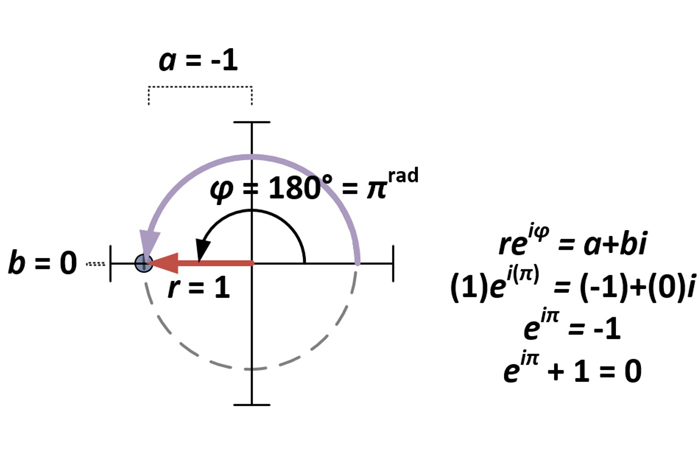
Image by Robert J. Coolman
#3 Boltzmann's Entropy Formula
\[S = k_B\log\Omega\]
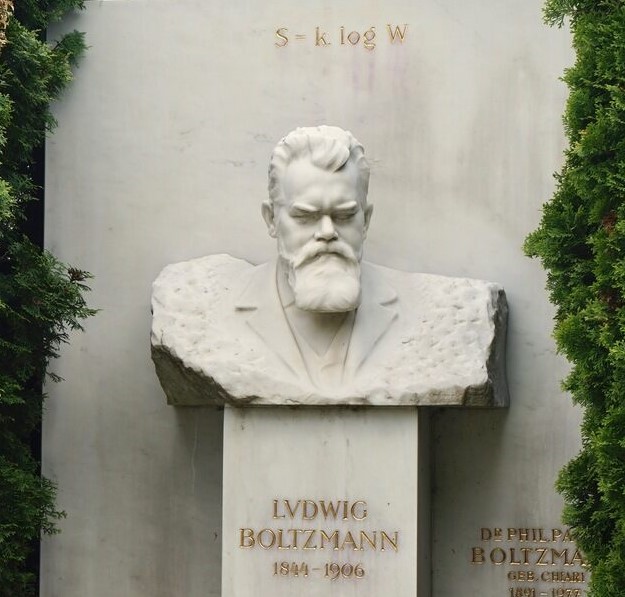
Originally formulated by Ludwig Boltzmann, the next equation explains how a system tends toward disorder in a concept called entropy. Physically, this formula relates a macroscopic state to the microstates or the number of ways the system's particles can be arranged. In words the equation is defined as: Entropy (S) = Boltzmann's constant (kB) x the logarithm of number of possible microstates (Ω)
An example of such a system is a container injected with particles of gas that are hot and cold. According to Boltzmann, you can expect the particles to spread evenly in the container while equalising the temperature. In other words, the particles maximise the number of energy states.

An analogous way of looking at entropy is to consider your house. Have you noticed how easy it is for your bedroom or kitchen to get dirty? It always gets messy and effortlessly so. It feels like it requires less energy to make it messy than to actually keep it clean. Statistically there are also more ways to distribute your stuff in space than not so no wonder it's always such a mess!
#2 Schrödinger Wave Equation
\[i\hbar\frac{d}{dt}|\Psi(t)\rangle = H|\Psi(t)\rangle\]
The next equation on the list is the most fundamental equation in quantum mechanics. As you may have gathered, the science of quantum physics is the science of the very (very) small. The Schrödinger wave equation was developed by Erwin Schrödinger who got the Nobel prize for it in 1933. It is used widely in physics and chemistry to solve problems concerning the atomic structure of things. The equation describes an important piece of information in a quantum system called the wave function (represented by the Greek letter psi - ψ). The wave function gives you a particle's characteristics like its position, momentum, spin and other observable quantities. Quite the powerful tool.

#1 Einstein Field Equation
\[G_{\mu\nu} + \Lambda g_{\mu\nu} = T_{\mu\nu}\]As Einstein said in the quote above, it's quite extraordinary that we are able to understand the laws of nature in the first place. Think about it. Why does the universe operate in a way that we can understand? Is it a matter of us projecting our orderly minds on an otherwise chaotic system? I won't go down those philosophical rabbit holes in this post. For now, my last equation is the Einstein Field Equation, or rather equations.
I chose to rank this equation as my number one favourite because of how powerful it is at describing the nature of space and time while elegantly encoding a huge amount of information in a short, simple-looking form.
Take Home Message
Congratulations for making it to the end of the post, oh brave soul! Thank you for coming on this journey with me. The aim is not to understand each and everything but hopefully I got to give you a glimpse of the fantastic world of physics and the language of mathematics used to navigate it. Bear in mind, these are just models to represent nature. Some models are better than others and the goal of physics is to describe nature in a way that best fits what we observe. These equations and many more have revealed the beautiful structure that is at the core of reality and expanded the way I see the world. The next time you climb a flight of stairs, drive home or watch a Youtube video, remember how grand and intricate this whole experience of life is. We truly live in an amazing universe.
[1] Appendix calculation: How much sugar does it take to power a South African home?
Energy in 1 kg mass:
According to this study, the average South African household consumes 9.171 MWh of electricity per year.
Therefore the energy contained in 1 kg of matter can power a home for:
This is over 2 million years worth of household energy.
[2] Appendix calculation: Derivation of the polar form of Euler's Identity.
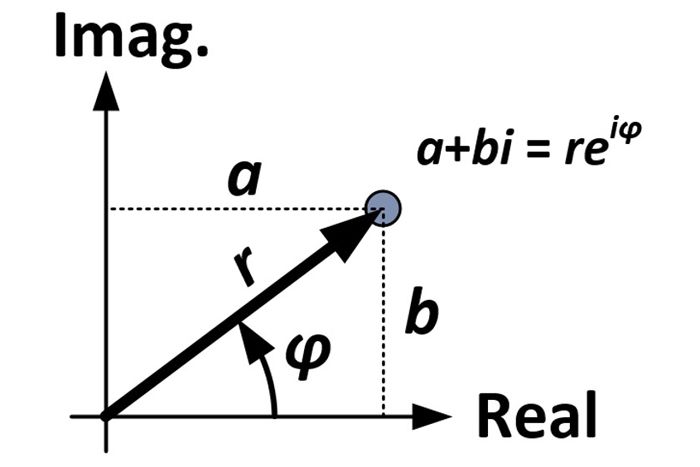
Image by Robert J Coolman
Starting with the rectangular form of a complex number:
\begin{eqnarray} a + bi \end{eqnarray}From the diagram and trigonometry, we can make the following substitutions:
\begin{eqnarray} (r\cos\phi) + (r\sin\phi)i\\ r(\cos\phi + i\sin\phi) \end{eqnarray}
Using the shorthand cisφ = cosφ + i.sinφ, the derivation is as follows:
\begin{eqnarray} cis\phi &=& \cos\phi + i\cdot\sin\phi\\ \frac{d}{d\phi}cis\phi &=& -\sin\phi + i\cdot\cos\phi\\ &=& (i^2)\sin\phi + i\cdot\cos\phi\\ &=& i\cdot(i\sin\phi + \cos\phi)\\ \frac{d}{d\phi}cis\phi&=& i\cdot cis\phi\\ \frac{dcis\phi}{cis\phi} &=& i\cdot d\phi \end{eqnarray}
For the initial value cis(0) = 1
\begin{eqnarray} \int^{cis\phi}_1\frac{dcis\phi}{cis\phi} &=& i \int^{\phi}_0d\phi\\ \ln\left(\frac{cis\phi}{1}\right) &=& i(\phi - 0)\\ \ln(cis\phi) &=& i\phi\\ cis\phi &=& e^{i\phi}\\ \cos\phi + i\cdot\sin\phi &=& e^{i\phi} \end{eqnarray}
Therefore r(cosφ+i.sinφ) is written in standard polar form reiφ.